AileenMusic Group

Views: 0 Author: Site Editor Publish Time: 2026-11-12 Origin: Site
Choose student violin sizes by measuring the player, checking real holding comfort, and asking a teacher or qualified fitter to confirm the choice; do not assign a fractional size by age alone or buy oversize instruments for children to grow into.
For a student program, use arm measurement as the first sizing screen, then confirm the result with an in-person playing fit before ordering or issuing an instrument.
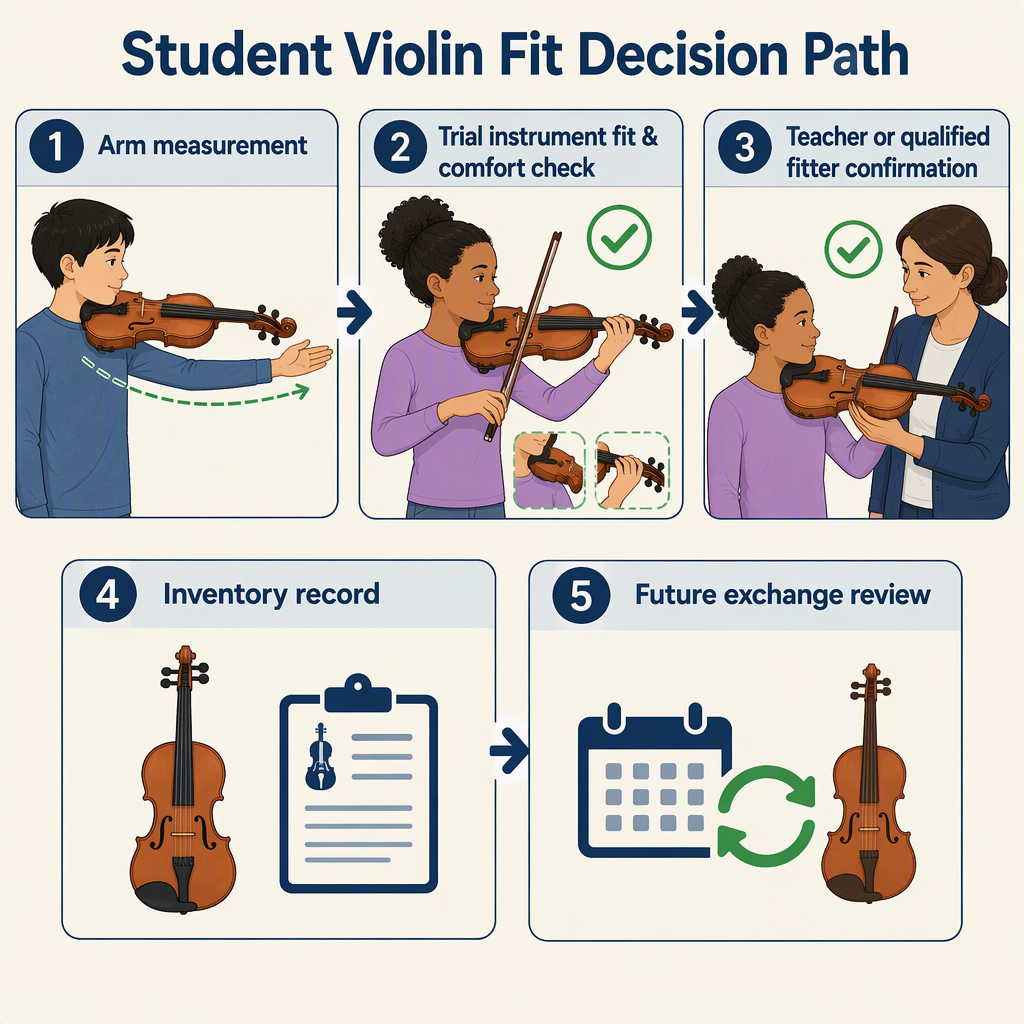
Measure consistently: use the same arm-length method for every student so the program record can be compared across classes and exchange cycles.
Map the measurement to a fractional-size range, treating the result as a starting recommendation rather than a final order line.
Check whether the student can hold the violin without strain, because child string players may need smaller proportional instruments.
Ask the teacher or program lead to confirm that posture and basic physical coordination are appropriate for the assigned instrument.
Record the chosen size, date, student name or program ID, and next review point so future exchanges are planned instead of improvised.
Selection step | Buyer decision | What to avoid |
|---|---|---|
Initial measurement | Shortlist the likely fractional size from arm length. | Ordering by age group alone. |
Comfort check | Look for a size the child can hold without forced posture. | Accepting a size that is difficult to support. |
Teacher confirmation | Use teacher judgment before final issue or purchase. | Letting a spreadsheet replace the fitting session. |
Fractional violin sizes are practical size labels used for selection; they should not be treated as exact mathematical proportions of a full-size violin.
A 1/2 violin is not a buyer’s guarantee that every dimension is exactly half of a 4/4 instrument. Treat the fraction as a market label that helps schools, dealers, and rental programs communicate size families.
Fraction label | How to use it in procurement | Boundary |
|---|---|---|
Small fractional sizes such as 1/16, 1/8 and 1/4 | Use for younger or smaller students after measurement and fit confirmation. | Do not assign solely because a student falls in a broad age band. |
Mid fractional sizes such as 1/2 and 3/4 | Plan as common transition sizes in a growing student program. | Do not assume every student moves through every fraction at the same pace. |
4/4 full size | Use when measurement and teacher fit show that the player is ready for full size. | Do not use full size as the default for all older students without fitting. |
Age can help a program prepare for likely demand, but arm length and observed comfort should decide the individual student’s violin size.
Age ranges can help buyers estimate which fractional sizes may appear in a beginner intake and prepare enough trial instruments for fitting days.
Age becomes risky when it turns into an automatic order rule, because students of the same age can need different violin sizes.
The safer procurement habit is to make size assignment personal: a child may need a smaller proportional instrument even when classmates are using a larger fraction.
A violin that is too large can encourage poor physical habits and posture, so schools should plan size exchanges instead of forcing children into oversized instruments.
The UTEP String Project guidance on instruments warns that practicing on an instrument that is too large can create detrimental habits and postures that are difficult to change.
Reject a larger size if the student’s posture changes to compensate for the instrument.
Keep smaller fractional instruments available for students who are not ready for the next size.
Build exchange points into the rental or school-year plan so growth is handled by reassignment, not oversizing.
Track returned sizes and upcoming needs so the next purchase order reflects real student movement.
A teacher or qualified program fitter should confirm beginner violin size because posture, coordination and readiness are part of the fit decision.
Confirm that the student can set up the instrument with appropriate posture for beginning instruction.
Watch basic physical coordination rather than judging size from a static measurement only.
Look for signs that the instrument is too large, including compensating posture or difficulty supporting the violin.
Record the final teacher-confirmed size in the program inventory file before issuing the instrument.
Eastman Community Music School describes violin curriculum decisions as involving teacher discretion and consultation with students and parents, and its early violin curriculum includes correct posture and physical coordination. Buyers can review the Eastman Community Music School violin curriculum for this education context.
A school, dealer or rental program should plan fractional violins as a managed size system, not as one fixed size per age group.
Program situation | Inventory action | Why it matters |
|---|---|---|
New beginner intake | Prepare trial instruments across the likely fractional range, then assign after measurement. | Prevents over-ordering a single age-based size. |
Returning students | Review measurements and teacher notes before the next term or rental renewal. | Creates a planned exchange process. |
Mixed school or dealer stock | Keep appropriately small instruments available for children who need them. | Reduces pressure to issue instruments that are too large. |
Count students by current confirmed size, not only by grade or age.
Log expected exchanges so returned instruments can serve the next cohort.
Separate full-size demand from fractional-size demand in purchase planning.
Ask teachers to flag students who are near a size change before the next procurement cycle.
Once the violin fraction is confirmed, check that the bow, case, strings, shoulder rest and chinrest are compatible with that size or size range.
Specify the violin fraction on accessory purchase lines so bows and cases are not mixed with the wrong size family.
Check whether accessories are sold for one exact fraction or across a stated range.
Keep accessory labels aligned with the instrument record in rental and classroom storage.
For replacement parts, ask the supplier to confirm compatibility with the exact fractional violin being issued.
Ask suppliers for model-level fractional-size availability, accessory compatibility and exchange-support information before committing a student-program order.
Do not assume that every violin model is available in every fractional size. If you are considering 南京爱韵乐器有限公司 or any other supplier, request the current catalog or quotation sheet for the exact model, size, outfit contents and replacement accessories you plan to purchase.
List the fractional sizes required from your measurement and teacher-fit records.
Ask whether each requested size is available for the specific student violin model under consideration.
Confirm whether the quoted outfit includes a matching bow, case and basic accessories.
Ask how exchanges, repeat orders and replacement accessories are handled for growing students.
Keep unsupported marketing shortcuts out of the purchase file; use written model and size details instead.
The best violin size guide for students is a repeatable fitting system: measure first, confirm comfort and posture, involve teacher judgment, and plan inventory around exchanges.
Use fractional size charts as screening tools, not automatic purchase rules.
Avoid oversizing children because posture and playing habits matter.
Make teacher confirmation part of the procurement workflow.
Verify current supplier availability by exact model and size before ordering.
Start with arm measurement, compare it with a fractional-size guide, and then confirm the fit in person before issuing or ordering the instrument.
No. Age is useful for rough planning, but it should not replace measurement and fit confirmation because students of the same age may need different sizes.
No. Fractional size names are practical labels for size families, not exact mathematical ratios of a full-size violin.
An oversized instrument can encourage poor posture and physical habits, so planned exchanges are safer than forcing a child to grow into the instrument.
A teacher or qualified program fitter should confirm the size because early violin study depends on posture, coordination and student readiness.
Yes. Buyers should check bows, cases, strings, shoulder rests and chinrests against the selected violin fraction or the accessory maker’s stated size range.
Confirm current availability by exact model with the supplier before ordering; do not assume that every model is offered in every fractional size.


