AileenMusic Group

Views: 0 Author: Site Editor Publish Time: 2026-11-09 Origin: Site
For violin and viola storage in schools, shops, and stockrooms, build routines around stable monitored humidity. Keep instruments and bows cased when not in use, wipe rosin after playing or demonstrations, and refer cracks, rattles, loose parts, bridge concerns, and repair questions to a qualified repair person.
A practical preventive routine monitors the room, keeps conditions stable, stores instruments closed in cases, cleans residue after use, and records environmental trends.
Place a reliable temperature and relative-humidity monitor where instruments are actually stored, not only in an office or corridor.
Record readings consistently enough to see trends, because collections-care guidance emphasizes monitoring and tracking over one-off readings.
Return each violin, viola, and bow to its case when it is not being played, demonstrated, inspected, or transported.
After classroom use, trials, or showroom demonstrations, wipe rosin dust from the instrument, strings, and bow stick before storage.
Treat storage, environment, housekeeping, inspection, pest awareness, and emergency planning as one care program.
Use humidity guidance as a source-qualified care band, not an invented warranty threshold: museum-sector guidance warns against inappropriate or fluctuating relative humidity and gives broad ranges for mixed and humidity-sensitive materials.
Museums Galleries Scotland explains that low, high, or fluctuating relative humidity can damage collection materials and that humidity-sensitive materials such as wood may need tighter care than less responsive materials. Its broad guidance includes avoiding conditions below 40% RH or above 70% RH for mixed collections, with 40–60% RH discussed for humidity-sensitive materials in collection contexts.
Do not convert those figures into a universal violin, viola, or supplier warranty rule. Use them to frame monitoring, ask for model-specific requirements, and investigate repeated swings before visible damage appears.
For the source-qualified environmental principle, see Museums Galleries Scotland guidance on temperature and humidity in museums, which emphasizes stable relative humidity, regular monitoring, calibrated equipment, and trend tracking.
Stable conditions matter because wood and other organic materials respond to moisture in the surrounding air; repeated swelling, shrinking, warping, cracking, or stress can develop when humidity is unsuitable or changes quickly.
Keep storage conditions as stable as practical and watch trends over time.
Allow gradual acclimatization when instruments move between different environments.
Use monitoring records to identify repeated humidity swings before they become a handling crisis.
Do not rely on a single reading to prove that the storage area is consistently safe.
Do not place wooden instruments in areas known for large heat or humidity changes without a plan to monitor and respond.
Do not treat broad museum guidance as a substitute for instrument-specific advice when warranty or setup questions are involved.
When a violin or viola is not being used, the case should be the default storage position, and the bow should be returned to the case rather than left loose.
Close the case after use so the instrument and bow are protected during classroom changeovers, sales conversations, and inventory counts.
Remove the shoulder rest before placing a violin or viola in its case, unless the case and supplier instructions specifically allow the fitted accessory.
Avoid exposing stored instruments to extreme heat or cold, including short stops in vehicles or unconditioned delivery areas.
Check that the bow is stored safely in its holder and not under pressure from loose accessories.
Keep a simple checkout or demonstration note so staff know which instruments need cleaning, bridge observation, or repair referral.
Daily cleaning for non-repair staff should stay simple: wipe rosin dust from the instrument, strings, and bow stick after playing, and avoid uninstructed polish.
After a lesson, rental return, or showroom trial, use a suitable dry cloth to remove rosin dust from the instrument surface.
Wipe the strings where rosin has accumulated, taking care not to turn routine cleaning into setup adjustment.
Wipe the bow stick and store the bow in its place in the case.
Look at the bridge angle as an observation step; if it appears to be leaning or out of position, route the instrument to a teacher or repair professional.
Do not apply commercial polish or cleaning products unless you have been instructed by a qualified person for that instrument and finish.
Routine staff care is not a repair bench. Do not attempt do-it-yourself repair, internal adjustment, seam work, crack work, or bridge correction as part of daily cleaning.
Inventory staff can clean, case, observe, and record; they should escalate rattles, loose internal wood, suspected soundpost issues, cracks, open seams, bridge problems, and any repair uncertainty to a qualified repair technician.
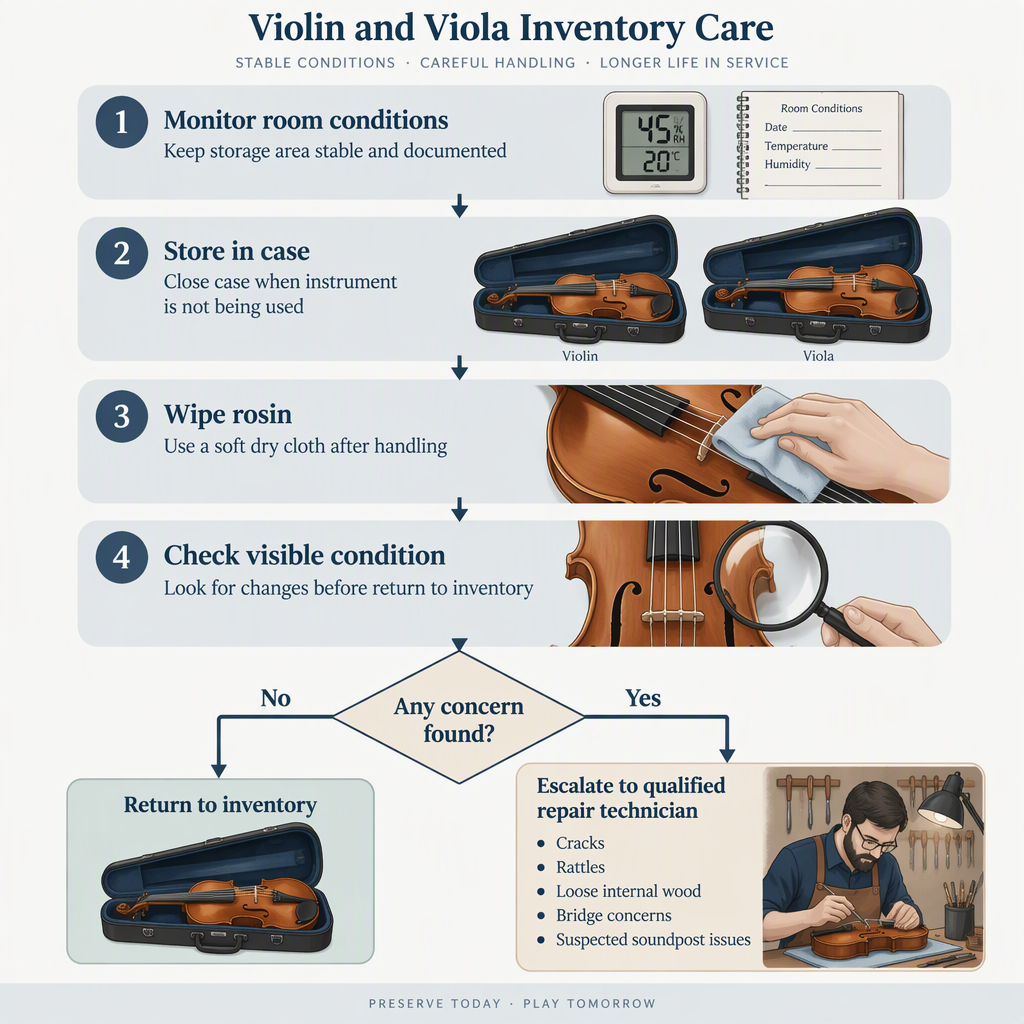
Observation | Routine staff action | Escalation point |
|---|---|---|
Rosin dust on strings, body, or bow stick | Wipe after playing or demonstration | Escalate if residue removal would require solvents, polish, or scraping |
Instrument or bow left out after use | Return it to the case when not in use | Escalate if the case fit, bow holder, or accessory placement appears unsafe |
Bridge appears to be leaning or misplaced | Record the condition and stop routine circulation | Send to a teacher or qualified repair person |
Rattle or loose internal wood is heard | Do not shake, probe, or open the instrument | Take it promptly to a repair technician |
Crack, open seam, or suspected structural problem | Tag the instrument and remove it from normal use | Refer the instrument for professional repair assessment |
If an instrument has electronics, powered accessories, humidification devices with batteries, or a powered display cabinet involved in the inspection area, switch off and disconnect the relevant power source before manual access, and follow the product manual for permitted access only.
A useful record system needs consistent humidity and temperature readings, visible-condition notes, storage location, and clear repair holds so staff can see patterns and act early.
Record storage-area temperature and relative humidity readings in the same place each time so trends are visible.
Note unusual swings, repeated high or low readings, and any room changes such as HVAC faults, window exposure, or seasonal transitions.
Track whether each instrument was returned to its case, wiped after use, and checked for obvious bridge or handling concerns.
Use a repair-hold status for instruments with rattles, loose internal pieces, cracks, open seams, or bridge concerns.
Include storage, environment, housekeeping, pest awareness, and emergency planning in the same care conversation, because institutional collection-care guidance treats preservation as a coordinated program.
For broader institutional context, the National Park Service Museum Handbook Part I landing page describes museum-collections guidance covering storage, environmental standards, biological infestation, integrated pest management, emergency planning, and related care topics.
Movement creates risk when instruments pass between storage rooms, classrooms, vehicles, delivery zones, and showroom floors, so staff should avoid extremes and let instruments adjust gradually.
Before moving stock, check whether the destination is unusually hot, cold, damp, or dry.
Keep the violin or viola in its case during transport between rooms, events, and vehicles.
When the instrument has moved between different environmental conditions, allow gradual acclimatization rather than immediate exposure to a sharply different room.
Record recurring problem routes, such as a display area near sunlight, a cold loading point, or a classroom with repeated humidity swings.
After movement, inspect for obvious bridge concerns, rattles, or handling damage before the instrument returns to circulation.
General care guidance overlaps for violins and violas, especially case storage, rosin wiping, bow handling, bridge observation, and repair escalation, but that does not make every violin instruction valid for every viola model or setup.
For mixed violin and viola inventory, use shared routines for cleaning, storage, and visible-condition checks, then ask the supplier, teacher, or qualified repair professional when the question involves case fit, shoulder-rest storage, setup, bridge position, soundpost concerns, string choice, or warranty requirements.
This boundary is especially important for schools and shops because staff may handle many instruments quickly; a simple overlap rule prevents routine care from becoming unsupported adjustment.
A good violin and viola storage program is a repeatable habit: monitor the environment, favor stable conditions, and use records to catch patterns.
Track temperature and relative humidity where instruments are stored, and respond to trends rather than isolated readings.
Keep instruments and bows in cases when not in use, and remove violin or viola shoulder rests before casing unless the case design and supplier guidance allow otherwise.
Wipe rosin dust after use, avoid uninstructed polish, and keep repair work out of routine staff cleaning.
Escalate cracks, rattles, loose internal wood, bridge concerns, soundpost concerns, and uncertain repairs to qualified help.
For shops, schools, and distributors, the practical next step is to make the checklist visible, assign recordkeeping responsibility, and review storage conditions as part of the wider care program.
These questions help staff apply the storage routine without turning general care guidance into unsupported repair or warranty rules.
Use source-qualified guidance as a monitoring reference, not a universal warranty threshold. Museum-sector guidance warns against low, high, or fluctuating RH and discusses broad ranges including avoiding below 40% or above 70% RH for mixed collections and 40–60% RH for humidity-sensitive materials in specific collection contexts.
Yes. Educational string-instrument care guidance advises keeping the instrument and bow in the case when not in use, which suits classrooms, shop demos, and distributor storage between inspections.
Yes, the guidance advises removing the shoulder rest before placing a violin or viola in its case. If a specific case is designed for fitted accessories, confirm that with the supplier rather than forcing the case closed.
Routine care can include wiping rosin dust from the instrument, bow stick, and strings after playing. Staff should avoid polish unless properly instructed and should not turn cleaning into repair or setup work.
Remove it from normal use when staff see cracks, open seams, bridge concerns, hear rattles, suspect loose internal wood, or are unsure whether an issue is safe for routine handling. Those conditions should go to a teacher or qualified repair technician.
Keep the record focused: storage location, temperature and RH readings, visible condition, cleaning completed, case returned, and repair-hold status. Consistent trend records are more useful than long notes that staff stop maintaining.
Use the shared principles for case storage, rosin wiping, bow care, bridge observation, and repair escalation, but confirm model-specific viola questions such as setup, case fit, and warranty requirements with the supplier or a qualified repair professional.
No. Museum guidance is useful for understanding stable environments, wood sensitivity, monitoring, and trend tracking, but it does not create a brand warranty threshold or a complete specification for every violin or viola.


